
Home

03 · The measuring principle

A calibration weight.
No drift.
Decades of precision.

The ring balance is a measuring principle without springs, without diaphragms — calibration is determined solely by a fixed weight and unchanging geometry. The result: no drift, constant accuracy over the entire service life.

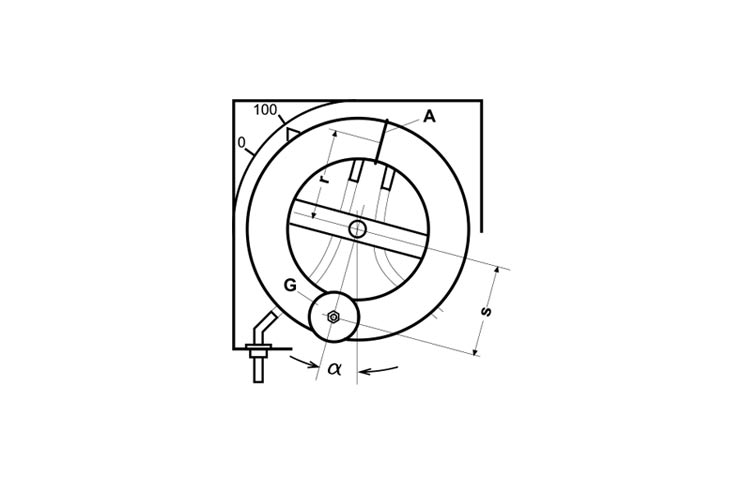
Δp ∝ sin α
Measuring principle
No drift
over decades
40 Pa
minimum range

01 — Why ring balance

Where sensors drift, mechanics stays stable.

Typical differential pressure sensors age: springs fatigue, diaphragms lose their elasticity. The ring balance has no memory effect — its calibration is determined solely by a fixed weight and unchanging lever lengths.

No memory effect

A weight does not age. The calibration remains constant over the entire service life — even after prolonged overload, the display returns reliably to zero.

From 40 Pa span

The smallest buildable span is 40 Pa — e.g. ±20 Pa, 0…40 Pa, or asymmetric −10…+30 Pa. All intermediate values are calibratable without extra charge.

Without auxiliary power

The mechanical display works without electricity. Optionally with 4–20 mA, 0–20 mA, 0–10 V, or as an intrinsically safe ATEX variant for hazardous areas.

02 — The principle compared

From the U-tube to the ring body.

The U-tube manometer is intuitive: pressure differences shift the liquid level, Δh is the measure. In the ring balance, rotation converts exactly this height difference into a large rotation angle — a few millimetres of level shift become tens of degrees.

Classical

U-tube manometer

Δp shifts the liquid level (Δh)

p+p−

Ring balance — same physics, different solution

Rixen ring balance

Δh → rotation angle — mechanical amplification

p+p−G
The key difference: Both instruments measure the same Δh — but the ring balance converts it into a rotation angle. A few millimetres of level shift become tens of degrees of deflection, depending on the measuring range. This mechanical amplification makes even the smallest pressures measurable without sensitive electronics.
p+p−−2000+200−100+100TGα = 0.00°

03 — Interactive measuring element

// Readout console

Δp · differential pressure0Pa
α · rotation angle0.00°
M · torque0.00mN·m
I · 4–20 mA output12.00mA
Differential pressure Δp0 Pa

// Explore components

Operation

Move the slider → ring rotates. A small oil level shift becomes a large rotation angle — mechanical amplification in action. "Overload" shows when oil is significantly displaced. Click a component for details.

04 — The principle in words

A pressure differential, translated into rotation.

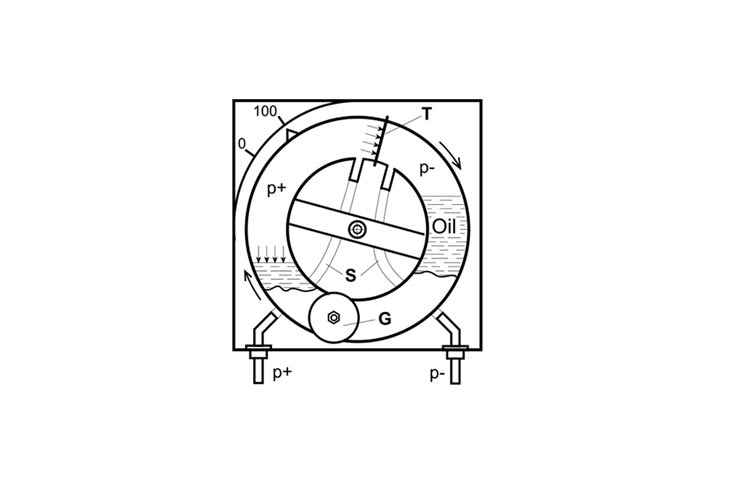
Imagine a ring-shaped tube, like a doughnut, suspended vertically and free to rotate. Inside it is half-filled with thin oil — and that is exactly the trick.

01The ring as a container with two chambers

At the very top sits a small dividing wall T that splits the upper hollow into a left and a right chamber. The oil at the bottom acts as a seal: gas cannot flow from one chamber to the other.

02At rest: nothing happens

When both pressures are equal, the ring stands upright. The oil level is balanced, the weight G hangs centrally below. The display shows zero.

03One side gets more pressure → ring rotates

If p₁ pushes harder than p₂, the gas shifts the dividing wall T to the side. Since T is rigidly attached to the ring, the entire ring rotates. Weight G is deflected sideways — and gravity pulls it back.

04Small Δh, large angle — mechanical amplification

The oil shifts like a U-tube: the level difference is small — just a few millimetres, depending on the measuring range. The ring balance converts this into a large angular deflection, making tiny pressures clearly visible and easy to measure electronically.

05Why this is so long-term stable

No spring, no diaphragm — only gravity and geometry. The calibration is determined solely by the mass G, the lever lengths, and the area of the dividing wall. These quantities do not change.

05 — The components

The ring body in detail.

The exploded view shows every individual component of the ring body — from the dividing wall and bearings to the connection plate. Each part has a defined function within the measuring principle. No electronics in the measuring path, no ageing components, no moving seals.

Fig. · Exploded view ring body · Rixen Messtechnik

Exploded view ring balance — all individual parts of the ring body with component labels
Zoom

06 — Dynamic behaviour

How quickly does the ring balance respond?

The ring balance exhibits first-order (PT1) settling behaviour — no overshoot, no oscillation. A smooth exponential approach to the final reading. This is an inherent characteristic of the measuring principle, not a defect.

≈ 12 s
Time constant τ
at 50 Pa range
> 0.997
Linearity R²
full measurement range
< 1.5 %
Hysteresis
of measurement range

Why PT1 behaviour?

When a pressure step occurs, the ring body does not jump instantly to its equilibrium angle but approaches it exponentially. The interplay of driving pressure torque, the restoring moment of the calibration weight, and the viscous damping of the sealing fluid produces the characteristic PT1 time constant. Larger pressure differentials drive the ring faster — at small measuring ranges the same mechanism results in a proportionally longer settling time.

Practical note: Do not perform zero adjustment until the ring has reached its stable final position.

Step response · ring balance · 50 Pa range · based on laboratory measurements

100 %63 %0 %0306090τ = 12 s≈ 65 sTime [s]Output [%]Δp applied
Zoom

07 — Areas of application

Where ring balances have been working for decades.

From cleanroom pressure hold to ATEX — wherever very small pressure differentials must be measured reliably and permanently.

Cleanrooms & operating theatres

Pressure hold against the corridor (typ. 5–30 Pa). No drift = no false alarms = no unwanted shutdowns.

Filter monitoring

Contamination indication in HEPA and submicron filters. Contact output or transmitter signal (4–20 mA, 0–20 mA, 0–10 V) signals replacement need.

Industrial furnaces & boilers

Draft measurement in flue duct. Insensitive to aggressive gases — ideal for corrosive atmospheres.

Volume flow measurement

Primary element (orifice, nozzle, Pitot) + ring balance. The transmitter output is linear to ΔP — since ΔP = k·Q², the BMS or SCADA applies the square root to derive volume flow.

Hazardous areas (ATEX)

RW65-Ex-II: ATEX II 1 GD, intrinsically safe 4–20 mA loop, stainless steel housing on request.

Building automation

Ventilation, smoke-control stairwells, climate regulation — everywhere small pressure differentials need to be permanently documented.

08 — Datasheet

Specification RW65 / MU-Analog

Every device is calibrated per order. All measuring spans between 40 Pa and ±1,800 Pa are available without extra charge. Factory calibration certificate included.

PropertyValue / range
Minimum range (span)40 Pa — e.g. ±20 Pa, 0…40 Pa, or −10…+30 Pa
Maximum range±1,800 Pa (±18 mbar)
Intermediate valuesall freely selectable, calibrated per order, no extra charge
Accuracy±1.5 % FS (> 100 Pa) or ±1.5 Pa (< 100 Pa)
Display unitsPa · daPa · kPa · mbar · mmWS · in.W.C.
Sealing fluid mineral oilρ ≈ 0.8 kg/L, for ranges ≤ ±700 Pa
Sealing fluid Galden®ρ ≈ 1.8 kg/L, for ranges > ±700 Pa
Overload (mineral oil)continuous up to ±700 Pa
Overload (Galden®)up to ±2.1 kPa
Ambient temperature−10 … +50 °C
Protection classIP65 (standard) / IP66 (stainless steel)
Scale size150 × 150 mm
Electrical output (active, 4-wire)4–20 mA · 0–20 mA · 0–10 V
Electrical output (passive, 2-wire)4–20 mA loop-powered (MU-Analog-65-2L)
Ex approval (RW65-Ex-II)ATEX II 1 GD Ex ia IIC/IIIC T4 Ga Da
ISO certificationDIN EN ISO 9001:2015

09 — Overload protection

DZ1 and DZ2 — optional protection against pressure surges

Every ring balance has a mechanical end stop. If the differential pressure exceeds the measuring range, the ring reaches that stop. DZ1 and DZ2 are optional factory-fitted accessories — useful when occasional pressure surges are expected in the application.

When the ring is on its stop and pressure continues to rise, the sealing fluid level climbs. As soon as it reaches the inlet of the DZ tube, oil is redirected to the opposite chamber — or air passes directly from one chamber to the other. The ring stays on its stop; once pressure returns to the measuring range, measurement resumes normally.

Ring balance at end stop with DZ bypass open — sealing fluid level reaches tube inlet, excess pressure escapes
Zoom

Fig. · Bypass open: excess pressure can escape · Rixen Messtechnik

DZ1 — single-sided

One diagonal tube connects one chamber to the other. Protects against occasional pressure surges in one direction — either overpressure or underpressure. Suitable when peaks are expected from one side only, for example in exhaust air systems or clean-room supply.

DZ2 — double-sided

Two crossed tubes, one for each direction. Protects against surges in both directions. Recommended when pressure can reverse — for example during start-up and shut-down phases or in processes with alternating pressure conditions.

The DZ is designed for occasional pressure surges in the region of the overload limit — not for sustained or extreme overpressure. If pressure significantly exceeding the measuring range is applied, the sealing fluid will be expelled regardless of the DZ. Correct instrument selection requires that operating pressure remains well within the measuring range.

Data sheet DZ1 & DZ2

DZ1 and DZ2 must be specified at the time of order and cannot be retrofitted.

We calibrate every ring balance individually to your measuring range.